Carbon Notes #0: Understanding WLCA Terminology
During 2024/25, I took part in the RICS WLCA training programme to study the intricacies of whole life carbon assessments — module by module. Along the way, I encountered confusion, misinterpretations, and frequent errors, both in my own work and in assessments I reviewed.
This series — Carbon Notes — is my way of sharing lessons learned and practical tips from the training and from real-world practice. Each post will unpack one module at a time. The first post starts with the basics: terminologies and assessment boundaries — because it’s essential we’re all speaking the same language.
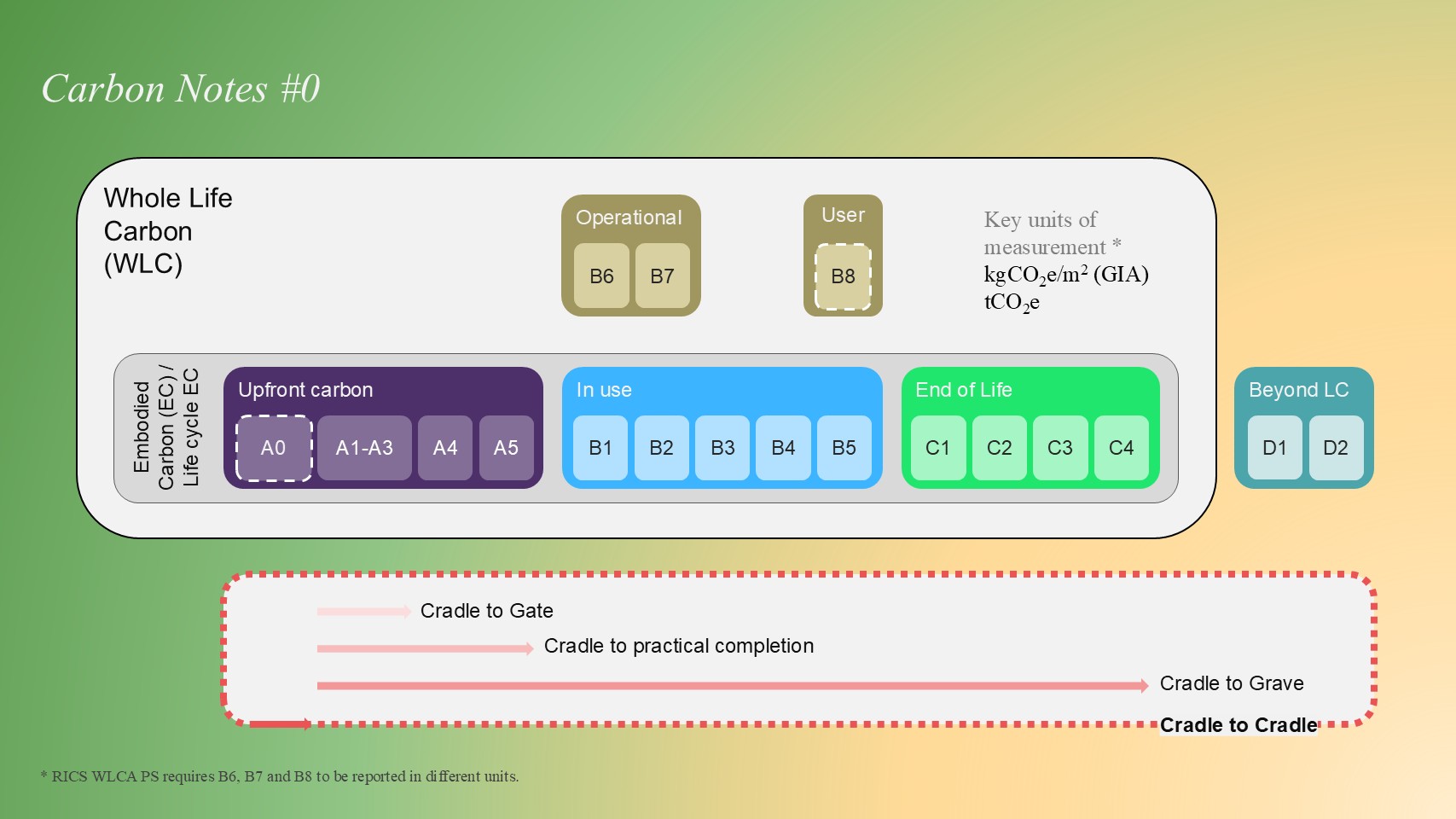
🧱 The RICS WLCA Professional Standard is built on a framework of modules (EN 15978):
- [A0–A5] Upfront Carbon**: From raw material sourcing to construction and installation. [A0] is new in the 2nd edition and optional for separate reporting — but should be included in upfront and embodied carbon.
- [B1–B5] In use: use, maintenance, repair, replacement, refurbishment.
- [B6–B7] Operational Carbon: Energy and water use during occupancy
- [B8] User Carbon: Also new and optional for separate reporting
- [C1–C4] End of Life: Deconstruction and demolition, transport, waste processing, disposal
- [D1–D2] Beyond Life Cycle: Benefits and loads beyond the system boundary: reuse, recycling, energy recovery and exported utilities (e.g. electricity, heat and portable water). It should be reported separately.
- 📌 Optional reporting ≠ optional assessment - Even for [A0] and [B8], data must still be collected and analysed — omission from reporting doesn’t mean exclusion from consideration.
🔁 Assessment boundaries to know:
The first edition of the standard also uses boundary-based terms mapped to life cycle modules:
- Cradle to Gate = A1–A3
- Cradle to Practical Completion = A1–A5
- Cradle to Grave = A1–C4
- Cradle to Cradle = A1–D2
The first three portray a linear asset life cycle. Cradle to Cradle, however, formalised by Michael Braungart and William McDonough (2002) promotes circular thinking.
📏 Units of measurement:
- kgCO₂e/m² (GIA) – standard unit for expressing carbon intensity
- tCO₂e – cumulative impacts by module or reporting boundary
- Exceptions - [B6] is reported in kWh/year, [B7] m3/day, although [B6-B7] collectively can be reported in kgCO₂e/year. [B8] is reported in kgCO₂e/year.
- Remember - CO₂e includes all greenhouse gases (GHGs), so the ‘e’ matters!